
Wounded Warrior Heath Calhoun honored with Lang Award for Courage
Retired Staff Sgt. Heath Calhoun, a former member of the 101st Airborne unit and a veteran of the Iraq war, received the 2007 George C. Lang Award for Courage.
Calhoun received the award for exemplifying the spirit of Lang, a Vietnam veteran, Congressional Medal of Honor recipient, and friend of the Wounded Warrior Project. Lang, who passed away in 2005, was an advocate for all veterans, especially those with disabilities.
Calhoun, also a Wounded Warrior, was severely injured when a rocket-propelled grenade hit his
Humvee in 2003, resulting in the amputation of both his legs above the knee.
During his seven months rehabilitating at Walter Reed, Calhoun became familiar with the Wound Warrior Project, which offers support and shared experiences to injured service men and women. After his rehabilitation, he joined the Wounded Warrior Project as a national spokesperson, lobbying for changes in law, and speaking to the public about the needs of the wounded, and counseling the newly injured as an Amputee Coalition of America (ACA) certified peer visitor.
He actively worked to get the Wounded Warrior Bill passed through Congress in 2005. Known as “traumatic injury protection,” the legislation financially assists wounded military and their families during the time of rehabilitation.
During his own time in rehabilitation, Calhoun said there was not anyone around who had the same injury he had.
“I was one of the first bi-lateral amputees at Walter Reed,” he explains. “While there were above-knee and below-knee amputees walking around, I saw no bi-lats. I didn’t know who to look up to.”
Although he was fitted with two prosthetic legs, and was able to walk with a cane, that wasn’t enough to satisfy Calhoun.
“I could walk a few steps, but any more than that and I needed to use a cane. It was not where I wanted to be,” he said. In fact, Calhoun found his prostheses so uncomfortable and walking so difficult, he thought he would never use his “legs” fully again and would need to always rely on a wheelchair.
“I was spending so much effort to learn how to walk and I felt I was not making any progress, which was not a good feeling,” he said. “I kept thinking there was something about my (residual limbs) that couldn’t be fit with prosthetics.” Then, another Wounded Warrior suggested he attend a workshop for bi-lateral amputees conducted by Kevin Carroll, CP, FAAOP, and Randy Richardson, RPA, at the national ACA conference in Minnesota.
“I saw five bi-lats walking,” he said, noting that athlete and triple amputee Cameron Clapp was there demonstrating his mobility.
“I started asking questions – why these guys could do it and I couldn’t,” he said. “After talking to them, I thought I would give prosthetics another try.”
As soon as he could, Calhoun visited Hanger Orthotics & Prosthetics in Oklahoma City. He began by relearning how to walk on shortened prosthetics, which are called stubbies.
SSG Heath Calhoun (ret.)
Driving forward with life…
By Karen Carney
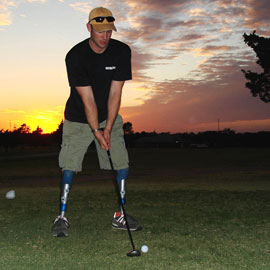
It’s a crisp bright morning on the 3rd hole of Torrey Pines Golf Course in La Jolla, California -- one of the nation’s premier municipal golf courses. With an eight iron in hand, Heath Calhoun steps onto the tee box and hits. The ball flies straight and true, landing neatly on the green about fifteen feet from the pin. His golf partners look on in awe.
True, the shot was perfect. And true, Heath has a natural swing. But what is remarkable about the shot, and the entire round for that matter, is that Heath is standing on his own legs, something that just a short while ago he didn’t think was a real possibility for him.
It took just seconds in 2003, when suddenly a lot of things didn’t seem possible. Staff Sergeant Calhoun and his convoy were attacked while serving in Iraq. But Heath understood the risks that come with serving one’s country.
At a young age, Heath earned respect for the U.S. military. His father served in Vietnam and his grandfather in World War II and in 1999, Heath made the decision to carry on their dedication to the military and to the service of his country when he enlisted in the U.S. Army. He completed his infantry training in Fort Benning, Georgia and was then deployed to Iraq where he was assigned as a Squad Leader for the famed 101st Airborne Division.
It was there his convoy was hit by a rocket propelled grenade. “I was at the rear corner of the Humvee when the grenade hit the tail light right beside my right leg,” he said. “I was lying on my side. I could see my legs were really messed up.” Heath yelled to the driver of the vehicle to call the incident in to headquarters. “I laid my head back down and that’s all I remember.”
The injuries he sustained ultimately resulted in the loss of both legs above the knees. Another soldier was killed in the attack. Heath wears a bracelet etched with the soldiers name and date of the attack on his right wrist in honor of his service.
Heath initially struggled with using prosthetic legs. He tried several different components including a pair of computerized knees but none were comfortable or practical. He eventually resigned himself to the fact that he would never be a full-time prosthetic user and would always rely on a wheelchair. But Heath is not a guy that stands still (just ask anyone who has ever met him) and he found ways to put his energies into other pursuits.
Providing encouragement and counseling for other amputees has become a serious interest for Heath. During his rehabilitation at Walter Reed Army Medical Center in Washington, DC, Heath became acquainted with the Wounded Warrior Project (WWP), a national organization dedicated to raising public awareness and aid for severely injured service men and women. The shared experiences of the group’s members proved to be invaluable to him during his recovery and later he wanted to so the same for others. So he began sharing his experiences, successes, struggles and the unique challenges that amputees face daily. Eventually, the group asked him to be a national spokesperson and now he speaks to, and counsels the newly injured around the country. He also became an Amputee Coalition of America (ACA) certified peer visitor. Through this organization he makes himself available to others who have lost limbs and provides emotional and informational support to them.
Additionally, Heath actively works as an advocate for the needs of the wounded soldier. His most notable accomplishment was helping to get the “Wounded Warrior Bill” passed through Congress in 2005. Known as “traumatic injury protection,” the legislation financially assists wounded soldiers and their families during the months, and sometimes years, of grueling rehabilitation.
Another major pursuit, for which Heath has quite a knack, is athletics. During his recovery, he was introduced to various adaptive sporting events and he immediately became an enthusiast. It seems that there is not a sport that Heath is not willing to try and, according to many, in which he doesn’t excel.
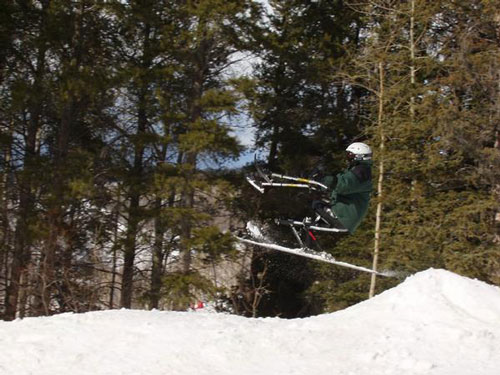
Just five months after he was injured he attended a Winter Sports Clinic in Aspen, Colorado where he attempted snow skiing for the first time. At the conclusion of the event Heath was awarded the Challenge Aspen Inspiration Award not just for his athleticism, but for the person “who best embodied the spirit of inspiration on and off the snow.“ He one day hopes to be a member of the U.S. Paralympic Ski Team and compete on the world stage.
In the spring of 2005, Heath participated in the Soldier Ride National Tour, an event that raised awareness and money to aid in the rehabilitation of injured soldiers returning home from conflicts abroad. He successfully completed the 4,200-mile cross-country bike ride utilizing a handcycle.
But even with all of his counseling and advocacy endeavors and his successes in sports, Heath still felt limited by the wheelchair. Early last summer, a fellow wounded soldier suggested he attend a workshop for bilateral above-the-knee amputees at the National ACA Conference in Minneapolis. The workshop brought together several bilateral above knee amputees that are full-time prosthetics users. “This workshop is about exploring possibilities,“ says moderator Kevin Carroll, MS, CP, FAAOP, Hanger V.P. of Prosthetics. “It’s a great venue for highlighting improvements, sharing experiences and fine-tuning skills. And for someone like Heath Calhoun, it can open a door and change a life.”
At the conference, Heath watched in awe as patients demonstrated negotiating stairs, ramps, even driving a car. “I was astounded to see what these people were doing. It was almost like they could function like a person with two natural legs.“ Right there, Heath decided to give prosthetics another try.
After training in short prosthetic legs for several weeks, he was fitted with Hanger ComfortFlex sockets and computerized knees. Just days after being fit, he was up and walking independently, without using canes or crutches.
The new legs energized Heath. He is not only walking, but running, swimming, even hiking. In November, he was part of a three person amputee relay team at the Challenged Athletes Triathlon in San Diego, completing a 1.2 mile swim event in 39:00 minutes and with record tide levels.
And while his new legs have given him the ability to try many new sports and activities the rewards of being able to walk go beyond athletics. “My prosthetic legs give me the option to do things on my own. To go out by myself, be spontaneous and more independent. If I want to take my son Mason to the driving range and hit a bucket of balls, or carry my two daughters around the house, I can just do it. Just knowing that is the best thing.“
So has Heath caught the ‘golfing bug’? “Oh, I don’t know. I like it and there are many who are encouraging me to be more involved in NAGA golf events, but I’m still looking for that one sport that I can put my all into.” Modest words, coming from a guy who seems to do extremely well in every sport he tries.
Which brings us back to Torrey Pines. Heath had just hit a beautiful, text book shot which landed with a terrific lie on the green and had the other players green with envy. So how did he end up on the hole? Birdie? Par? Heath chuckles. “Well I three-putted the hole. I guess I need to work on my putting a little more.“
Home page